HR technology is one of those categories where AI-generated recommendations are starting to quietly reshape purchasing decisions — and most of the companies in the space haven’t noticed yet.
Think about how HR leaders now research software. A VP of People at a 500-person company is evaluating ATS platforms, or looking for an HRIS that integrates with their existing payroll system, or trying to figure out which recruiting analytics tools are actually worth the budget. Increasingly, that research journey starts with an AI assistant. “What are the best applicant tracking systems for fast-growing tech companies?” or “which HR platforms are good for companies with hourly workers?” — these are real queries people are asking real AI systems.
The answers those AI systems give are shaping shortlists. And in a crowded HR tech market, being on the AI-generated shortlist or not can be the difference between getting into a deal and never knowing it existed.
The HR Tech Market’s Specific Challenges
HR tech is a fascinating category for LLM SEO specifically because it’s so fragmented. There are hundreds of vendors at every layer of the stack — ATS, HRIS, performance management, compensation platforms, benefits administration, workforce analytics, DEI tools, recruiting ops software. The category language is inconsistent across vendors and buyers. And enterprise HR software deals often involve multiple stakeholders with different information needs.
This fragmentation creates both challenges and opportunities. On the challenge side: AI models sometimes struggle to differentiate between vendors that use similar category language but serve meaningfully different market segments. If your product is designed for hourly workforce management and an AI model conflates you with enterprise white-collar HRIS platforms, you’re getting cited in the wrong contexts.
On the opportunity side: category clarity cuts through in this environment. A vendor with a precisely defined entity — specific industries, specific company sizes, specific workflow problems — is easier for AI models to cite accurately when the right query comes in. Precision beats breadth in LLM visibility for niche categories.
What HR Leaders Are Asking AI Assistants
Understanding the query landscape for HR tech is essential for building a relevant LLM SEO strategy. HR leaders tend to ask AI questions that fall into a few categories.
Category-level discovery: “What are the leading ATS platforms for mid-market companies?” or “Which HRIS vendors work well for international teams?” These are the foundational visibility questions — showing up here means you’re on the mental map.
Use-case specific: “What software helps with unstructured interview feedback analysis?” or “Which platforms automate I-9 compliance for distributed teams?” These are more specific and often closer to purchase intent. Being cited here requires that AI models understand your specific capabilities with enough depth to match them to specific problems.
Comparison questions: “How does [Vendor A] compare to [Vendor B] for manufacturing workforces?” These queries draw from comparison content across the web — review platforms, analyst reports, community discussions, independent comparison posts.
Each of these query types requires a somewhat different content and coverage strategy, and understanding which ones are most relevant to your specific positioning helps allocate investment appropriately.
The Content and Coverage Mix That Works for HR Tech
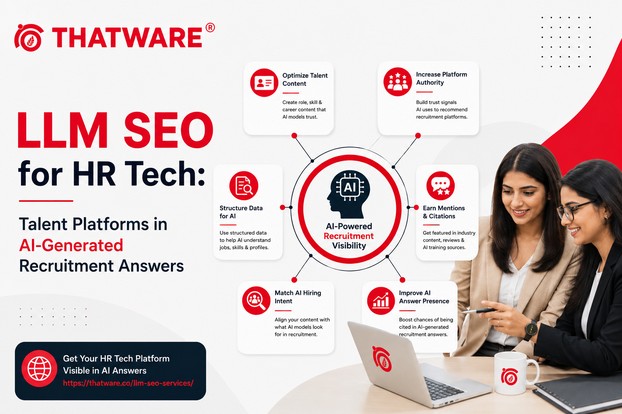
HR tech LLMs citation tends to require a broader content ecosystem than many vendors have built. A few specific investments that carry significant weight:
Use-case content with industry specificity. Generic “benefits of ATS software” content doesn’t drive AI citations in a competitive category. But “how construction companies manage high-volume seasonal hiring” or “what distributed engineering teams need from performance management software” — specific enough to match specific queries, authoritative enough to be citable — does.
Third-party analyst and research coverage. HR tech has a robust analyst community — SHRM research, Bersin/Deloitte, Gartner, Forrester, and numerous independent research firms. Appearing in their research — even in the “notable vendors” tier rather than the leadership quadrant — contributes significantly to LLM credibility. Models weight analyst coverage as strong authority signals in enterprise software categories.
Customer stories from recognizable organizations. In HR tech, the “who uses this” signal is enormously influential. A case study from a recognized brand — even a mid-market name that’s well-known in a specific industry — provides AI models with concrete evidence about the kind of company your platform serves well.
LLM SEO services for B2B SaaS adapted for HR tech should include a deliberate strategy for each of these content and coverage dimensions — not just general brand awareness work, but targeted investments in the specific query categories where HR leaders are making purchasing decisions via AI.
The Role of G2, Capterra, and Peer Review Platforms
In enterprise HR software, peer review platforms like G2 and Capterra play a particularly important role in AI visibility. These platforms are well-indexed, their content is highly structured (making it easy for models to extract specific claims), and their reviews tend to be detailed because enterprise buyers write more substantive feedback.
A strong presence on these platforms — not just aggregate star rating, but detailed, specific reviews that describe the types of companies using your product and the specific use cases they’re applying it to — is one of the most reliable AI citation drivers in the HR tech space.
The quality dimension matters here as much as the quantity. Fifty detailed, contextual reviews outperform two hundred generic ones for LLM visibility purposes.
Compliance and Security Content as a Trust Signal
One thing HR tech companies can leverage that’s specific to their category: compliance and security documentation. HR software handles sensitive employee data, operates under complex regulatory frameworks (HIPAA in health benefits, EEOC requirements in recruiting, CCPA and GDPR for employee data), and requires demonstrable security standards.
Publishing substantive content about how your platform handles compliance requirements, what security standards you meet and why, and how you approach data privacy isn’t just reassuring for prospects — it’s the kind of specific, verifiable, credibility-establishing content that AI models weight highly. It answers questions that HR leaders genuinely ask AI assistants: “Is [Platform] HIPAA compliant?” or “which ATS platforms have SOC 2 Type II certification?”
Best LLM SEO agency services for HR tech companies should identify these compliance and credibility content opportunities and build them into the overall content strategy. In a category where trust is a primary purchase driver, trust-establishing content isn’t just good PR — it’s direct LLM SEO investment.
The HR tech market is becoming increasingly AI-mediated at the discovery layer. Vendors that build their LLM visibility now, while many competitors are still asleep on it, will find that their brand shows up exactly when buyers are forming their initial consideration sets.